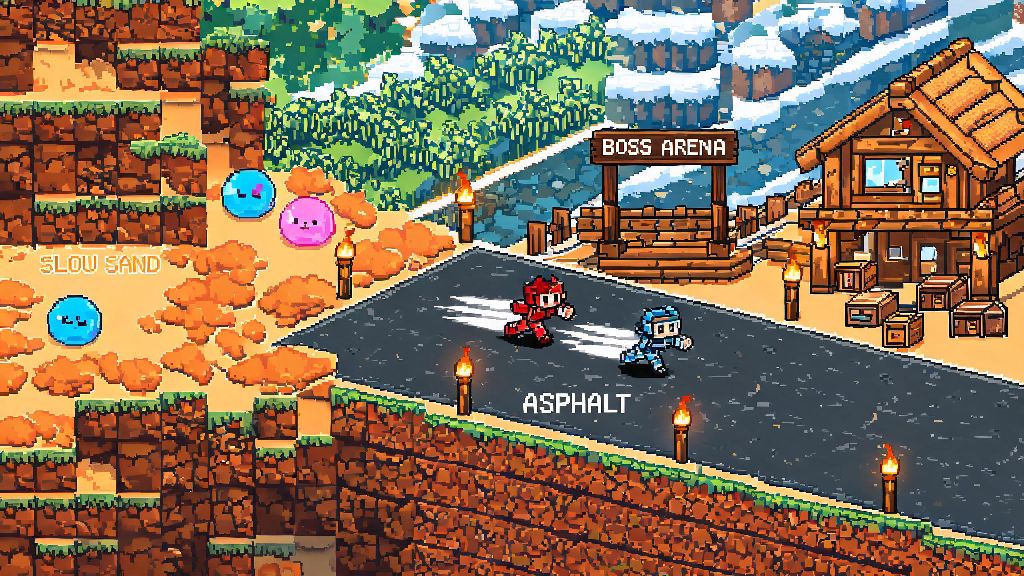
If you’ve ever sprinted across your Terraria world only to get stuck on slimes, cliffs, or slow sand blocks mid-errand, you know how frustrating wasted travel time can be. One of the best low-effort quality of life upgrades you can add to any playthrough is a network of paved walkways, and that’s where learning how to make asphalt in Terraria becomes a game-changer. Asphalt blocks give you a huge movement speed boost when you walk on them, and they’re far easier to craft than most late-game mobility upgrades, even if you’re still in early Hardmode. I’ve used asphalt paths in every one of my playthroughs over the last 7 years, and I still find new spots to lay them to cut down on time spent running between biomes, boss arenas, and my base.
What You’ll Need to Make Asphalt in Terraria
Before you can start crafting asphalt, you’ll need to check off a few small prerequisites first. Unlike basic blocks like wood or stone, asphalt requires a special crafting station that only becomes available once you reach Hardmode, so you won’t be able to make it in pre-Hardmode playthroughs. All the materials are easy to farm once you know where to look, and you won’t need any rare drops or high-tier tools to gather them. The full list of items you’ll need is:
Don’t stress if you haven’t found the Underground Desert yet. It generates in every world, usually right below the surface Desert biome, and you can spot it easily by its sandy brown stone walls and pools of tar that slow you down when you step in them. If you’re playing a modded playthrough, some mod packs change the recipe slightly, but this is the vanilla recipe that works for all unmodified Terraria versions 1.4 and later. You don’t need any special crafting buffs or rare items to make asphalt, which is part of why it’s so accessible for early Hardmode players.
Step-by-Step Crafting Process for Asphalt Blocks
First, you’ll need to defeat your first mechanical boss. If you’re struggling to take one down early in Hardmode, I recommend farming for a good ranged weapon like the Daedalus Stormbow first, paired with Jester Arrows, to take out The Destroyer in under 10 minutes even with pre-Hardmode armor. I once tried to craft asphalt before I unlocked the Steampunker on a new playthrough, and spent 20 minutes searching my crafting menu for the recipe before I remembered I needed the Blend-O-Matic first. Don’t make that same mistake.
Once the boss is defeated, the Steampunker will spawn as long as you have an empty house ready. Head to her shop, pick up the Blend-O-Matic, and place it anywhere near your base crafting area for easy access. Next, gather your materials. I recommend farming at least 500 of each material first if you plan to pave long paths across your world, since each craft gives you two asphalt blocks for every one of each input. That means 500 of each material will get you 1000 asphalt blocks, enough to pave a path from the ocean on one side of your world to the ocean on the other with some left over.
Once you have all your materials, stand near the Blend-O-Matic, open your crafting menu, and select the asphalt block recipe to craft as many as you need. You can stack asphalt blocks up to 999 in a single inventory slot, so you won’t have to worry about filling up your inventory mid-craft if you’re making a big batch. I usually keep a small stack of 100 asphalt blocks in my inventory at all times when I’m exploring new areas, so I can pave quick paths over dangerous terrain like lava pools or corruption chasms to make return trips easier.
Best Uses for Asphalt Blocks in Your Terraria World
Asphalt blocks give you a 30% movement speed boost when you walk or run on them, and that stacks with other movement speed buffs like the Swiftness potion, Hermes Boots, or the later Terra Boots upgrades. That means with a full set of mobility buffs, you can run nearly twice as fast on asphalt as you can on regular grass or stone. The most common use for asphalt is paving long cross-world paths that connect your base to key locations like the Dungeon, Jungle, Hell entrance, and boss arenas. These paths make it so much faster to grab supplies for boss fights or restock on farmed resources without spending 10 minutes running across empty terrain.
You can also use asphalt to line the floors of your boss arenas to make dodging attacks far easier, especially for fast-moving bosses like Skeletron Prime or the Moon Lord. I’ve cut my Moon Lord fight time in half by lining the entire arena floor with asphalt, since I can dart out of the way of his laser attacks far faster than I could on regular stone. Asphalt blocks also don’t spread corruption, crimson, or hallow, so you can use them as a barrier to stop biomes from spreading into areas you want to keep unmodified. That’s a huge bonus if you’re trying to protect your base or a specific farm from being taken over by hostile biomes.
I’ve also used asphalt blocks for mini-game tracks for multiplayer servers, like boat races or obstacle courses, since the speed boost makes the games far more dynamic and fun for everyone playing. You can even use them to make fast travel paths through dangerous biomes like the Corruption or Crimson, so you don’t have to stop to fight every enemy that spawns while you’re passing through.
Common Mistakes to Avoid When Working With Asphalt
Even though asphalt is pretty straightforward to craft and use, I’ve made my fair share of mistakes with it over the years that I wish I’d known to avoid earlier. First, don’t waste your early Hardmode gold on the Blend-O-Matic before you have your basic Hardmode gear sorted. 10 gold isn’t a huge amount, but if you’re still struggling to afford new armor or weapons, hold off for a few hours until you have extra coins to spare.
Second, don’t mine Tar Blocks without a potion of Obsidian Skin or a way to move quickly through tar. Tar slows you down by 50% when you step in it, and Underground Deserts are full of hard-hitting enemies like Sand Sharks and Mummies that can take you out easily if you’re stuck moving slowly. I usually bring a stack of Swiftness potions with me when I farm Tar Blocks, so I can move at normal speed even when I’m standing in tar pools.
Never place asphalt blocks directly next to water unless you want them to turn into Dirt Blocks – that’s a little-known vanilla mechanic that a lot of new players miss, and I’ve lost entire stretches of path to rainstorms before I realized this was happening. If you want to build a path over water, place a layer of stone blocks under the asphalt first to keep it separated from the water, or build the path one block above the water line to avoid contact entirely. Another common mistake is forgetting that the speed boost only works if you’re directly touching the asphalt. If you place carpet, pressure plates, or other blocks on top of the asphalt, you won’t get the speed bonus, so keep your paths clear of extra blocks if you want the full effect.
At the end of the day, adding asphalt paths to your world is one of the simplest upgrades you can make to cut down on tedious travel time and make your entire playthrough feel smoother. Whether you’re a casual player who just wants to get from your base to the Jungle faster, or a hardcore player looking to optimize boss fight arenas, taking the time to learn how to make asphalt in Terraria is well worth the small effort it takes to gather the materials and craft them. I still add new paths to my worlds even 100+ hours into a playthrough, and I’ve never regretted the time I spent farming the materials to make them. Give it a try on your next playthrough, and you’ll wonder how you ever played without asphalt paths.