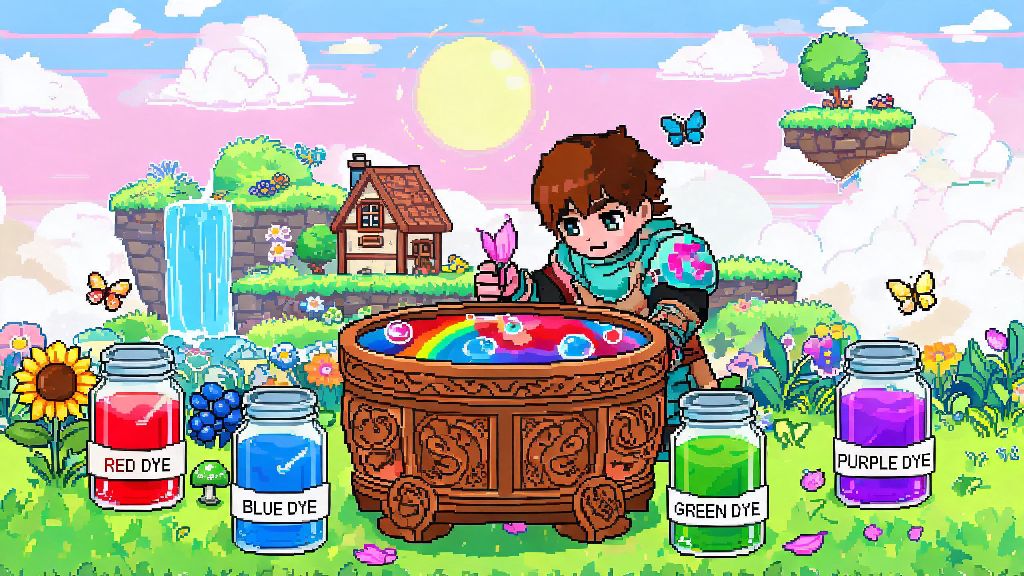
If you’ve ever stared at your plain iron armor or boring wooden house base and wished you could add a pop of personality, you’re in the right place. Learning how to make dye in Terraria is one of the simplest, most rewarding ways to make your playthrough feel uniquely yours, no matter if you’re playing on classic, expert, or master mode. You don’t need late-game gear to get started either – most basic dyes are craftable within the first few hours of a new world. I’ve spent dozens of hours testing different dye combinations for my own vanity sets and base builds, so I’m breaking down everything you need to know to skip the frustrating guesswork.
How to Make Dye in Terraria: Core Crafting Basics
Before you can craft any dye, you’ll need access to a Dye Vat, the only crafting station required for all dye recipes. The Dye Vat is sold by the Dye Trader NPC for 5 gold, and he’ll move into an empty house in your world as soon as you have any dye material or strange plant in your inventory. You don’t need to beat any bosses or reach Hardmode to unlock him, so you can get him set up very early in your playthrough if you prioritize collecting a few basic dye materials first.
All basic dyes only require one of their corresponding crafting material, no extra ingredients needed. For example, one red berry makes one red dye, one cactus makes one green dye, and one blue berry makes one blue dye. You don’t need to unlock any special crafting recipes to make basic dyes – they’re automatically available as soon as you have a Dye Vat and the required materials in your inventory. The only exception is special and rare dyes, which have slightly more complex crafting requirements we’ll cover later.
Once you’ve crafted your dye, you can apply it by opening your inventory and placing the dye in the small dye slot next to the item you want to color. You can dye armor, vanity items, accessories, pets, mounts, and even your grappling hook. Dyes only affect the visual appearance of items, so they won’t change any stats or functional perks of your gear. That means you can dye your best endgame armor any color you want without worrying about losing its damage or defense bonuses.
Easy Materials to Farm for Your First Dyes
You don’t have to explore dangerous biomes or fight tough enemies to get materials for your first batch of dyes. Most basic dye materials spawn in common, low-risk biomes you’ll already be exploring in the first few hours of a new playthrough. I recommend collecting a handful of these materials as you run around the surface gathering wood and ore, so you’re ready to craft dyes as soon as the Dye Trader moves in.
All of these materials respawn over time, so you can set up small farms near your base if you want a constant supply of your favorite dye colors. If you’re playing with a friend, split up to farm different biomes at the same time – you can trade materials to get twice as many dye options in half the time. I do this with my co-op partner all the time, and we usually have 10+ different dye colors within the first two hours of starting a new world.
Rare and Special Dye Variants Worth Hunting For
Once you’ve played around with basic dyes, you can start hunting for rarer, more unique dye variants that add extra flair to your items. Gradient dyes are the easiest special dyes to make first – you just combine two different basic dyes at the Dye Vat to create a smooth color gradient. For example, combining red and purple dye makes a red-purple gradient dye, and combining blue and green dye makes a blue-green gradient dye. You can mix any two basic dyes to create a custom gradient that fits your style.
Bright dyes are another popular option, especially for players who spend a lot of time exploring dark underground caves. To make a bright dye, combine one basic dye with one Bright Pixie Dust, which drops from Pixies in the Hallow biome once you unlock Hardmode. Bright dyes glow in dark areas, making them perfect for players who explore lots of underground caves without a light pet equipped. I use bright orange dye on all my mining gear, and it makes it way easier to see my character when I’m digging through dark chasms full of enemies.
The rarest dyes in the game come from trading Strange Plants to the Dye Trader. Strange Plants are rare, randomly spawning plants that grow in all biomes, both above and below ground. Each Strange Plant can be traded for 3 random rare dyes, including animated variants like Flames Dye, Confetti Dye, and Rainbow Dye. Some event-exclusive dyes also drop from seasonal events like the Frost Moon and Pumpkin Moon, so keep an eye out for those if you play during event seasons. Never trade a Strange Plant to the Dye Trader until you have an empty inventory slot for the dyes you’ll receive – you won’t get a second chance to collect them if your inventory is full.
Pro Tips for Using Dye in Your Playthrough
You don’t have to dye every single item you own the same color. Mixing and matching dye colors on different armor and vanity pieces lets you create completely custom looks that no other player will have. I once dyed my helmet black, chestplate red, and leggings gold to make a custom pirate set, and I got so many compliments on it when I played in public co-op lobbies. You can even dye individual accessories different colors to add extra small details to your look.
Don’t confuse dye with paint, which is sold by the Painter NPC. Dye only affects wearable items, pets, and mounts, while paint is used to color blocks, furniture, and walls for base builds. You can use both together to create a fully cohesive custom world – for example, dye your vanity set the same color as your base walls to make everything feel coordinated.
If you don’t like how a dye looks on your item, you can remove it at any time by right-clicking the dye slot next to the item. You’ll get the dye back in your inventory, so you don’t have to worry about wasting rare materials if you change your mind about a color. If you’re making a vanity set for a boss fight, pick a dye color that stands out against the boss’s arena background so you can keep track of your character easily during chaotic fights. I learned this the hard way when I dyed my armor dark gray for a Moon Lord fight, and I could barely see where my character was standing against the dark space background.
I once spent 2 hours hunting for a Strange Plant just to get Rainbow Dye for my endgame Solar Flare armor, and it was totally worth it to make my set stand out from every other player I’ve played co-op with. You don’t have to go that far if you don’t want to, but small cosmetic touches like custom dyes make the game feel a lot more personal and fun.
At the end of the day, learning how to make dye in Terraria is all about having fun and making your playthrough feel personal. You don’t need to follow any strict rules for what colors to use or what items to dye – experiment with different combinations until you find something that fits your style. If you’re just starting out, stick to the basic easy-to-farm dyes first, then work your way up to rare and animated variants as you progress through Hardmode. Even small cosmetic changes can make a huge difference in how much you enjoy your time in the world, so don’t sleep on this simple crafting system.