Anyone who’s spawned into a new Terraria world knows the first 10 minutes are chaotic: you’re punching trees, dodging aggressive slimes, and realizing you can’t reach that floating iron ore vein above you without falling and losing half your health. That’s where learning how to make rope on Terraria becomes one of the first critical skills you’ll pick up, long before you get grappling hooks or wings. Rope doesn’t get nearly as much hype as swords or magic weapons, but it’s the workhorse of early exploration, base building, and even boss fight arenas. I’ve played through over 20 Terraria playthroughs on every difficulty, and I still keep a stack of 500+ rope in my inventory at all times, even when I’m late-game with endgame mobility gear.
What You Need to Make Rope on Terraria
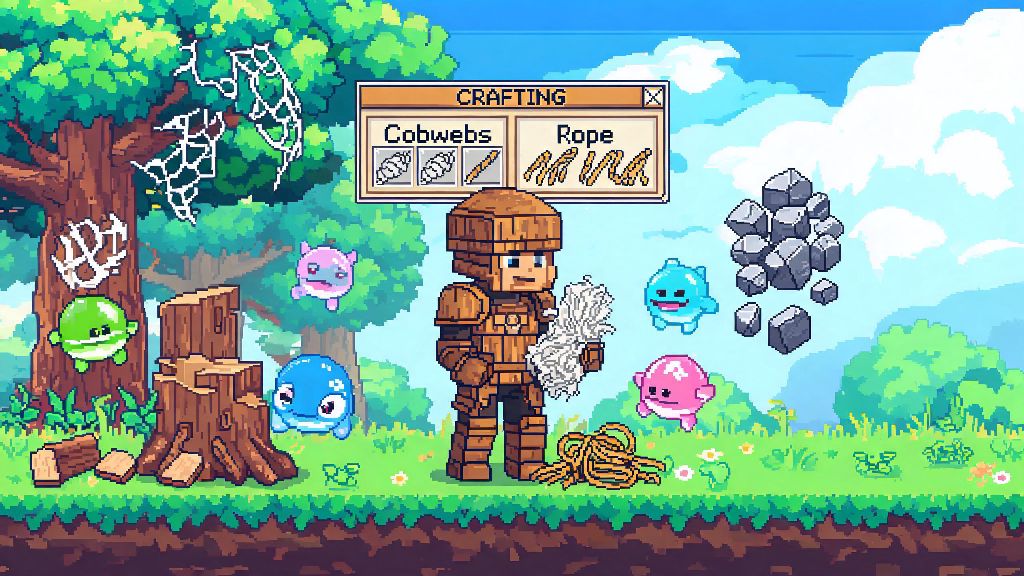
The basic rope recipe is far simpler than most new players expect, and you can unlock it within minutes of spawning into a new world. All you need to craft standard rope is cobwebs, the thin white wispy blocks you’ll find scattered in almost every underground cave, abandoned mine shaft, or underground cabin. The base recipe gives you one piece of rope for every one cobweb you collect, no extra materials required.
You don’t need any crafting station to make basic rope—you can craft it directly in your personal inventory grid as soon as you collect cobwebs, no workbench, anvil, or other station needed. That means you can farm cobwebs while exploring a cave and turn them into usable rope on the spot, no need to run back to base first. Cobwebs respawn over time in underground areas, so you can revisit the same cave every few in-game days to restock without having to explore new, more dangerous terrain.
If you’re new to farming cobwebs for rope, watch out for these common mistakes that slow you down or put you at risk:
Cobwebs do slow you down when you walk through them, so it’s best to clear a small safe area before you start farming in a new cave. I usually bring a cheap copper sword for cobweb farming, since it breaks every cobweb in one swing and handles any small enemies that pop up without wasting durability on my main pickaxe.
Alternate Ways to Get Rope Without Crafting
Crafting rope from cobwebs isn’t your only option, especially if you hate exploring dark caves early on or you run out of cobwebs mid-adventure. There are a few reliable ways to get pre-made rope without farming or crafting anything, and most of them are accessible within the first hour of a new playthrough.
The easiest method is to buy rope from the Merchant NPC, who moves into a valid empty house as soon as you have 50 silver coins in your inventory. The Merchant sells unlimited stacks of rope for 1 copper each, which is incredibly cheap even for early-game players. You can get enough copper to buy 100 rope just from killing 20 or 30 slimes near your spawn point. I usually buy 300 rope from the Merchant as soon as he moves in, so I don’t have to waste time farming cobwebs for the rest of early game.
You can also find rope as random loot in almost every chest in the game, from basic surface wooden chests to rare underground golden chests. Rope found in chests or pots is already pre-crafted, so you can use it immediately without having to process it first. On Expert and Master mode, chests spawn with 2x more rope on average, which is a small quality of life buff to help you survive the harder difficulty. If you’re exploring the Jungle, you can also get vine rope as a drop from Man Eater enemies, which works exactly like standard rope but has a green, vine-like texture that’s great for jungle-themed base builds.
Best Uses for Rope in Early and Late Game
A lot of new players write off rope as a temporary item they can replace as soon as they get a grappling hook, but rope has useful functions all the way through to endgame. In early game, its most obvious use is for safe vertical traversal: you can place rope down the side of a steep cliff or deep cave to climb up and down as fast as you can walk, with no stamina cost or risk of falling if you miss a jump. I always place rope as I dig down into a new cave system, so I don’t have to waste blocks building a staircase to get back to the surface later.
Rope is also incredibly useful for early boss fight arenas. For the Eye of Cthulhu or Eater of Worlds fights, placing a few vertical rope lines down the back of your arena gives you extra mobility to dodge attacks without falling off the edge. You can grab onto rope mid-jump to correct your position, or climb up quickly to avoid ground-based attacks from bosses like King Slime.
Rope does not block enemy spawns, so it’s perfect for late-game mob farm builds where you need to move freely around the farm without lowering monster spawn rates. You can run up and down rope lines in a mob farm to collect drops without having to build permanent platforms that block spawns. Rope is also great for building safe paths through dangerous biomes like the Underworld: you can place horizontal rope lines over lava lakes to cross without burning, or place vertical rope lines to climb up ash mountains without triggering fire imp spawns on the ground. You can break a rope at any point to remove all connected rope below it, which makes cleaning up temporary exploration paths or old mob farm builds super fast, no need to break each individual piece of rope one by one.
Pro Tips to Get the Most Out of Your Rope
After hundreds of hours playing Terraria, I’ve picked up a few little-known rope tricks that make the item even more useful, even for veteran players. First, always carry at least 200 rope with you when you go exploring, even if you have a grappling hook, wings, and other endgame mobility items. Grappling hooks can miss their target, or you can get knocked off a platform by a boss attack, and rope is a quick, reliable safety net to catch yourself before you fall into lava or a deep pit. I’ve survived so many otherwise fatal falls just by spamming rope placement as I’m falling.
You can place rope on the sides of blocks, not just the top or bottom, so you can create horizontal rope lines for easy traversal across wide gaps or lava lakes. A lot of new players only use rope for vertical climbs, but horizontal rope lines work just as well as temporary platforms, and they’re faster to place and remove. If you’re building a large base, you can also craft silk rope by combining standard rope with silk at a loom, which gives you a softer white rope that looks better for decorative builds, or vine rope for jungle-themed bases.
If you’re playing on Master mode, you can use rope to cheese a few early boss fights too. For the Eye of Cthulhu fight, build a tall tower of blocks with a rope line running up the side, and climb up and down the rope as the Eye charges at you. The Eye can’t hit you easily when you’re moving vertically on rope, and you can shoot at it with a bow as you climb. Just make sure you clear any slimes from the base of the tower before the fight starts, so you don’t get knocked off when you climb back down.
Rope is one of those underrated Terraria items that makes every part of the game easier, from your first cave dive to your final Moon Lord fight. Knowing how to make rope on Terraria takes 30 seconds of learning, but it saves you hours of frustration from falling, getting lost, or being stuck without a way to reach high areas. Don’t sleep on stocking up on rope before every adventure, even if you think you have enough mobility items to get by. You never know when you’ll stumble on a deep cave system full of rare ore that you can’t reach without a little extra length.