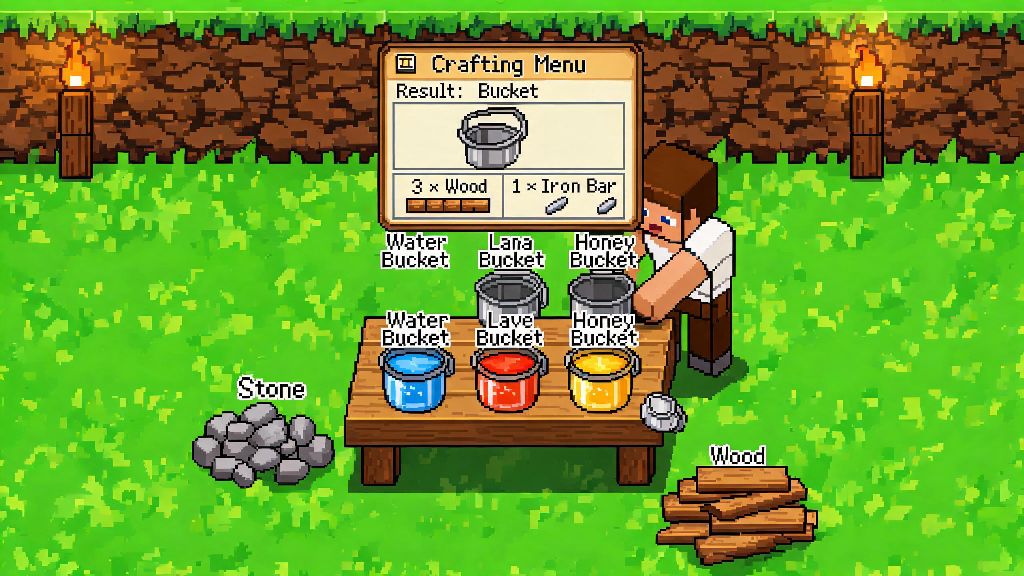
If you’re booting up Terraria for the first time in 2026, or coming back after a long break to try the latest minor content updates, you’ll quickly learn that some seemingly basic items are far more essential than they look. Few low-tier tools check as many boxes as the humble water, lava, or honey bucket, and figuring out how to make a bucket in Terraria is one of the first small wins that will make your early survival runs way less frustrating. I’ve been playing Terraria on and off for over a decade, and I still keep a stack of 3-4 buckets in my hotbar at all times, even when I’m farming endgame bosses. You’d be shocked how often you’ll need to move liquids, put out fires, or even make a quick emergency platform mid-fight.
What You Need to Make a Bucket in Terraria (2026 Updated Recipe)
The base bucket recipe hasn’t changed with 2026’s small quality-of-life updates, which is a relief for veteran players who don’t want to re-learn core crafting recipes. You only need two key ingredients to make a standard iron or lead bucket, both of which are easy to find within your first hour of playing a new world. Don’t waste time hunting for rare materials here; this is an item you can craft before you even fight the Eye of Cthulhu, if you prioritize mining a few extra ore veins early on.
One common mistake new players make in 2026 is saving all their early iron for armor or tools. I always recommend setting aside 3 extra bars first for a bucket, because being able to move water can help you make safe mining spots, stop cave fires, and even create a quick healing pool with honey if you find a bee hive early. You can always mine more ore in 10 minutes, but dying to a random cave fire because you couldn’t put it out will cost you far more time in lost loot and travel back to your base.
Step-by-Step Crafting Process for New 2026 Terraria Players
Crafting your first bucket takes less than two minutes once you have the required materials, even if you’re still getting used to Terraria’s 2026 UI updates that rearranged some crafting menu categories. First, make sure you’ve smelted your raw iron or lead ore into bars at a furnace, which you can make with 20 stone, 4 wood, and 3 torches at a work bench. If you’re having trouble finding iron or lead, stick to mining at depths between 0 and 300 feet below the surface; those levels have the highest spawn rates for both ore types in 2026’s world generation algorithm.
Once you have your bars and anvil placed, stand near the anvil and open your crafting menu; the bucket should appear in the tools section of the menu, even if you haven’t unlocked it as a known recipe yet. If you don’t see it, double check that you’re standing close enough to the anvil, and that you have at least 3 bars in your inventory, not stored in a nearby chest. The 2026 update added a range indicator for crafting stations, so you can look for the small blue icon next to the anvil’s name to confirm you’re in range to use it.
Keep the empty bucket in your hotbar once it’s crafted so you can quickly grab it whenever you run into a liquid source while exploring caves. If you accidentally delete it or lose it to a cave death, you can make a new one for the same low cost, so don’t stress too much about guarding it like a rare endgame item. I usually make 2 or 3 buckets at once when I first get access to iron, just to avoid having to run back to my base to craft another one mid-exploration run.
Hidden Uses for Buckets Most 2026 Terraria Players Miss
Most new players only use buckets to move water for building farms or putting out fires, but they have dozens of niche uses that make them worth keeping around for your entire playthrough. For example, a lava bucket is one of the best early game light sources you can carry, as it emits way more light than a torch and doesn’t break when you pick it back up. You can place it down to light up a large cave section while you mine, then pick it back up when you’re ready to move on, no extra resources wasted.
You can also use water buckets to create temporary bridges over lava lakes when you’re exploring the underworld for the first time, without wasting valuable building materials. Just pour the water over the edge of the lava lake, and it will turn the top layer of lava into obsidian that you can walk across safely. Pick the water back up once you’re done, and you can reuse it for the next lava lake you run into.
One of my favorite underrated uses for buckets in 2026 is creating quick healing stations mid-boss fight. If you keep a honey bucket in your hotbar, you can place a 1-block pool of honey at your feet whenever your health gets low, and the honey regeneration buff will stack with your healing potions to get you back to full health twice as fast. That trick has saved me from losing dozens of expert mode boss fights over the years, and it still works with the latest 2026 balance updates. You can also use buckets to create custom fishing spots anywhere on your map, even in the sky or deep underground. If you place 300+ blocks of water in an enclosed area, you can use it to fish for biome-specific loot without having to travel to the far corners of your world. That’s a huge time saver if you’re trying to complete the 2026 Angler quest line as fast as possible to get rare fishing rewards.
Common Bucket Mistakes to Avoid in 2026 Terraria Runs
Even seasoned players make silly mistakes with buckets from time to time, and the 2026 UI changes have caused a few new errors that I’ve seen pop up in community playthroughs over the last few months. First, don’t try to fill a bucket with a partial liquid block; you need to click on a full, static source block to fill it, or you’ll just waste a click and end up with an empty bucket still in your hand. If you’re playing on controller, make sure you’re not accidentally pressing the build button when you mean to pick up liquid, as the new controller shortcut layout added in 2026 can make that an easy mix-up if you haven’t adjusted your settings yet.
Another common mistake is using a single bucket for all three liquid types. If you have a bucket filled with water, you can’t pour it out and pick up lava in the same trip without first emptying the water somewhere safe, so I always recommend keeping one separate bucket for each liquid type once you have extra ore to spare. That way you won’t accidentally dump water on a lava vein you were trying to collect for your obsidian farm. It’s also a good idea to label your chests for filled buckets so you don’t mix them up when you’re grabbing supplies for a long exploration run.
Finally, don’t forget that buckets can be combined with other materials to make upgraded items later in the game, like the bottomless water bucket or lava absorber, so you won’t waste the bars you spent on your early buckets. You can even use filled buckets as ammunition for the water gun or lava launcher if you’re doing a silly ranged-only playthrough. The only real mistake you can make with buckets is not crafting one early enough in your run.
At the end of the day, learning how to make a bucket in Terraria is one of those small, foundational skills that will make every part of your 2026 playthrough smoother, from early game mining to endgame base building. You don’t need any fancy gear or rare materials to make one, and the benefits far outweigh the small cost of 3 metal bars. Next time you start a new world, make crafting a bucket one of your first priorities after you make your first set of stone tools, and you’ll wonder how you ever played without one in your hotbar.