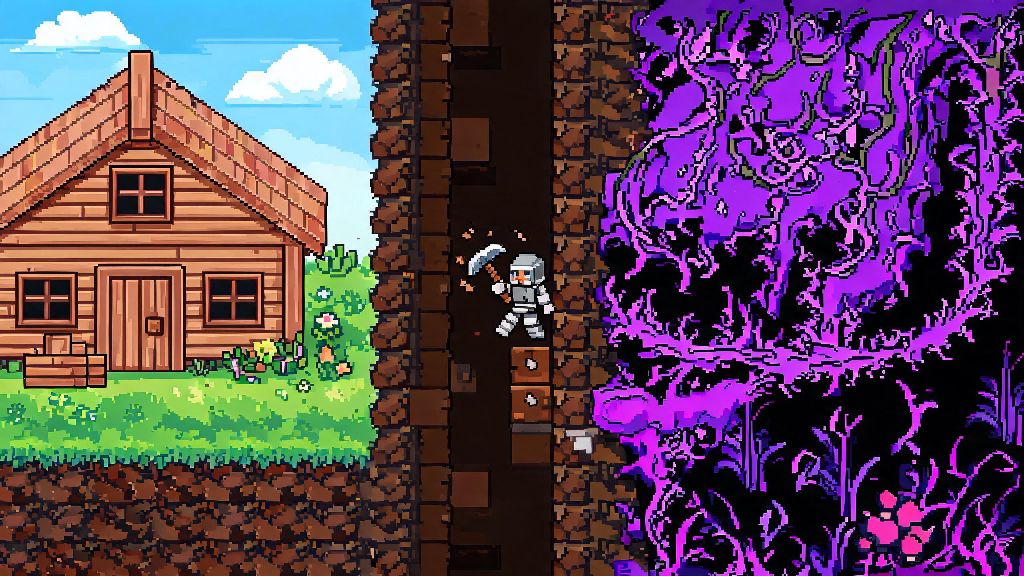
There’s no worse feeling in Terraria than logging back into your world after a long mining trip to find that glowing purple corruption grass has crept all the way up to the edge of your carefully built cottage. It eats through wood, turns slimes into dangerous corrupted variants, and can even lock you out of peaceful biomes you rely on for resources. If you’re wondering how do you stop corruption in terraria, you’re far from the only player who’s scrambled to fix this problem before it takes over your entire save. The good news is you don’t need endgame gear to get it under control, as long as you act fast and use the right strategies for your progression level.
How Do You Stop Corruption in Terraria Pre-Hardmode Without Rare Items
Pre-hardmode, corruption spreads very slowly, so you can block it effectively with materials you can collect within your first few hours of play. The most basic defense is digging hellevators, 3-block wide trenches that run from the surface all the way down to the underworld, spaced at least 120 blocks apart across your world. Corruption can only jump 3 blocks horizontally pre-hardmode, so this gap will stop it from crossing to uncorrupted areas entirely as long as you line the trench edges with immune blocks. Wood is not safe, but stone brick, clay, glass, and obsidian are all immune to corruption spread, so you don’t have to farm rare materials to line your trenches. If you don’t have time to dig full hellevators right away, plant sunflowers along the edge of any exposed corruption biomes. Sunflowers block corruption spread in a 12-block radius around them, and only cost 1 sunflower seed and 1 dirt block to place, making them perfect for temporary protection while you work on more permanent defenses.
Hardmode Corruption Blocking Strategies for Long-Term World Safety
Once you beat the Wall of Flesh, everything changes. Corruption spreads 3x faster, can jump 6 blocks instead of 3, and even spreads through regular stone blocks you may have thought were safe. Your old pre-hardmode trenches won’t cut it anymore, so you’ll need to update your defenses right away to avoid losing large parts of your world. The most game-changing tool you can get for hardmode corruption control is the Clentaminator, sold by the Steampunker NPC once you have a valid house for her post-Wall of Flesh. Pair it with green solution, and you can turn corrupted blocks back to normal in seconds, making quick work of small spread patches before they get out of hand. For long-term protection, follow these simple barrier best practices:
Common Mistakes That Let Corruption Sneak Past Your Defenses
Even if you think you’ve set up perfect barriers, there are a few easy mistakes that can undo all your hard work in just a few in-game days. The most common one I see new players make is forgetting that corruption spreads through background walls. If you have corrupted dirt walls in a cavern near your base, the corruption can jump across gaps through those walls even if you have a perfectly sized trench. You’ll need to break any corrupted walls within 10 blocks of your barriers, or replace them with non-corruptible walls like stone brick, to avoid this. Another mistake is leaving floating corruption blocks above or below your barriers. If a corrupted block is 6 blocks or less away from a normal block on the other side of your trench, it can jump right over, so always scan above and below your trenches when you build them to make sure there are no stray corrupted blocks. I made this mistake on my first playthrough, I lined my trench with wood thinking it was fine, came back a week later and the corruption had eaten through the whole thing. It’s a small oversight but it can cost you hours of cleanup work.
Permanent Solutions to Eradicate Existing Corruption Entirely
If you’re tired of checking for spread every time you log on, there are ways to get rid of corruption entirely so you never have to worry about it again. First, you can use the Clentaminator with green solution to spray every corrupted block in your world, but that can take a lot of time if your world is large. Beating Plantera will slow corruption spread by 50% by default, so it’s much easier to attempt full eradication after you’ve taken down that boss. You can also use the Dryad’s in-game world status report to track how much corruption is left, so you don’t have to search every corner of the map manually. If you’re playing modded, there are plenty of mods that add custom anti-corruption blocks or automated spread removal tools, but even vanilla players can fully wipe corruption if they put in the work. If you’re starting a brand new world and don’t want to deal with corruption at all, you can use a custom seed that spawns with no corruption, but that takes away a lot of the game’s core survival challenge, so most players prefer to build their own defenses instead.
At the end of the day, stopping corruption doesn’t have to be a stressful, constant chore if you plan ahead and build your defenses early, even if you’re just starting out on your first playthrough. Whether you’re planting sunflowers along your base edge in pre-hardmode or spraying your entire world with a Clentaminator post-Plantera, there’s a solution that fits every playstyle and progression level. Now that you know how do you stop corruption in terraria, you can spend less time cleaning up purple grass and more time exploring, building, and taking on the game’s hardest bosses without worrying about your hard work getting eaten away.